
Letters to a Friend
 FOREWORD
by Mary Cadogan
£10.00 inc P&P – Buy Now via Ebay
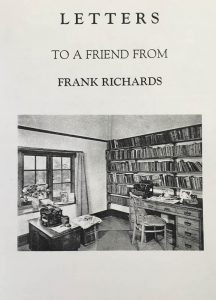
Frank Richards died on Christmas Eve 1961 and, to mark the fortieth anniversary of his passing, John Wernham and I are delighted to publish this collection of his letters to Joe Wark, a fan who, over the many years of the correspondence, became a friend. Frank Richards also wrote regularly to Joe’s small daughter, Margaret, who read and loved his stories too.
Frank’s letters are sometimes amusing and sometimes touching. Both he and Joe had problems with their eyesight which they discussed in their letters and, sadly, after Frank died, Joe became blind.
 He greatly regretted that he could no longer read his beloved Magnets and Gems. Becoming aware of this, I enlisted the help of Alex, my husband, and we tape-recorded several Magnets of Joe’s choice for him. Sometimes he requested the old double numbers — and reading these long stories aloud largely in character was quite a demanding task!
Joe was tremendously appreciative, and his pleasure in listening to these audio-Magnets was a delight to Alex and myself.
When Joe died some years ago his widow very kindly gave me the letters from Frank Richards which Joe had kept and said I could publish these if ever I would like to do so.
 Here they are, as a tribute to Frank Richards and Joe Wark who were both, as can be gleaned from their letters, true gentlemen of the old school.
I would like to express my warm thanks to Una Hamilton Wright, Frank Richards’ niece, for writing an introduction to this book and, as the copyright holder, so readily agreeing to the publication of these letters.
As always, I am deeply grateful to John Wernham and his extremely able and willing colleague, Gail Roots, for producing this book through The Museum Press.
A Strange Secret
 Preface to the Second Edition
£5.00 inc P&P – Buy Now via Ebay
Some years ago, I had occasion to call at the offices of Amalgamated Press to discuss the question of copyright and to seek permission to re-print an old Magnet story. I recall meeting Mr Leonard Matthews and receiving the all clear to go ahead. We then began to discuss old favourite papers and he produced a copy of his own particular choice. It was a Bolsover story, which, although written by a substitute author, had apparently found favour and when I asked why this should be the case no reason was offered, except that ‘he just liked it’.
We all have our own ‘reading periods’ and I can offer no logical reason why the Outram incident should occupy a special niche among all those early memories that appear to stay with us over the years. The story is typical: a new boy with a strange history; the unpleasant Levison and the golden-heated Gussy, with plenty of bullying and fighting.
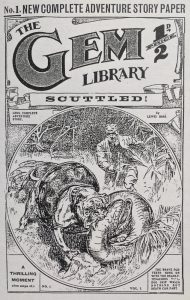 Of course the story moves with all the pace and narrative style that Charles Hamilton knew only too well how to provide and out new young reader was only too ready to be entranced at the tender age of nine innocent years. Yet, I can still read the good old ‘ham’ with relish the defeat of Weekes and Co. at the hands of our unwilling pugilist.
A Strange Secret (5)The jubilee edition, published in 1966 rapidly sold out and there were many disappointed customers, so now, in celebration of the ninety years since the birth of the Gem, we present once again this early story and I am hoping that old readers will share my enthusiasm for Gems 436-437 and re-discover for themselves the true nature of the mystery of A Strange Secret.
March 1977
John Wernham
The Housemaster's Homecoming
 £5.00 inc P&P – Buy Now via Ebay
Of all the many characters drawn by Charles Hamilton it is unquestionably true that the introduction of Talbot into St. Jim’s provided the young reader of half a century ago with a series of stories of a dramatic intensity that was something entirely new in the history of the school. In the seven years that had elapsed since the birth of the Gem, Hamilton had covered his canvas with a variety of interesting types most of whom had taken up their respective roles in the narrative, week by week, with steady reliance. Talbot, on the other hand, made no such dignified entry within the “venerable walls of the old school.” Rather, it could be said, that he “burst upon the scene” with an effect, and an impact, that brought a new element into the quiet stream of japes, smoky rotters, bumpings, ink, treacle and soot, that made up the weekly dose of Gem stories.
Of course, Talbot belongs to his period and many have expressed the view that it would have been better if he had finally departed from the pages of the Gem at an early date, and so have avoided those tiresome resurrections of the old ghosts that were wont to give Talbot the glumps, and the reader an even worse attack. Be that as it may, St Jim’s would have been the poorer with- out the presence of the steady reform that grew out of the old Talbot into the new, in spite of the determined efforts of the more shady characters to seek out some weakness in that reformation.
The story of the Housemaster’s homecoming also belongs to its period. German bands were a chronic joke of the time; wounded war heroes returned from the fighting were much in the news and an irascible colonel, complete with a Haig-type moustache, could scarcely fail to thrill the boys of the day. On the civilian front, “gentlemen cracksmen” of the Rames variety had been in vogue for some years and the introduction of these somewhat doubtful social activities directly into schoolboy life, created a stir that dominated the scene at St. Jim’s during the years 1914 and 15.
 Practically nothing of this atmosphere has survived the passing of the years and the Talbot character has declined, merely to become an improbable representation of juvenile delinquency who, at the age of fifteen, behaved like an adult and exhibited the extremes of badness and goodness to an unacceptable degree. That Hamilton was aware of this is clear from his reference to Talbot’s “gravity beyond his years” and it is reasonable to suggest that youthful wits are likely to be unduly sharpened under the prevailing conditions in Angel Alley. Perhaps the principal weakness in the Talbot theme is the rapid change of heart following such an upbringing although, here again, it could be argued that the friendship, and faith, established between the captain of the form and the new boy are the only ingredients necessary to work the miracle.
The Housemasters Homecoming (2)Whatever opinion has to say about all this, the Housemaster’s Home. coming remains a rattling good yarn. Talbot is suspect, as usual, but the ghosts are benign and, for the first time in his history, the family roots are firmly established and Crooke, now the rascally cousin, is thoroughly discomfited: honour is restored and Railton’s wounded shoulder is mended. The tension surrounding the meeting of the school governors is a masterpiece of writing. Talbot’s flight, the accident and the discovery of the locket is a little melodramatic, but, it must be remembered, we are back in 1915 and must accept the fashion of the time.
During the fifty years that Charles Hamilton was writing stories for boys many of his characters were of humble, or unknown origin. They were usually chaps of sterling worth and won all hearts with their noble qualities. Perhaps, after all, obscurity combined with tough measures in the early years makes for the best training and it is likely that the author saw the truth when he restored Talbot, the lost sheep, to his friends and discredited the black sheep, in Crooke of the Shell.
This new edition of a famous story has been prepared in response to several requests and it is to be hoped that all our members, and friends, will welcome a chance to re-read an old favorite in a modern format.
The colours have been specially added to the illustrations as a tribute to the memory of our good friend, Len Packman, who loved the Gem as much as any of us.
Maidstone 1970
John Wernharn
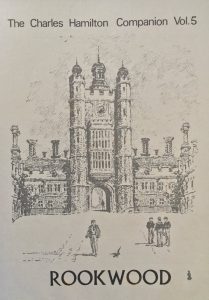
Rookwood. The Charles Hamilton Companion Vol.5
 Rookwood
£5.00 inc P&P – Buy Now via Ebay
Rookwood was elevated to the Peerage in the pages of the Penny Popular on Friday, April 21st 1917. This was no mean achievement. St. Jim’s and Greyfriars had provided the weekly dose of gracious living in that best of all possible worlds, the Public School, for ten years, and now the newcomer, scarcely two years old, was cheerfully taking a share of the limelight and insisting upon our attention, in spite of the allurements and the well-trodden paths of those other two schools.
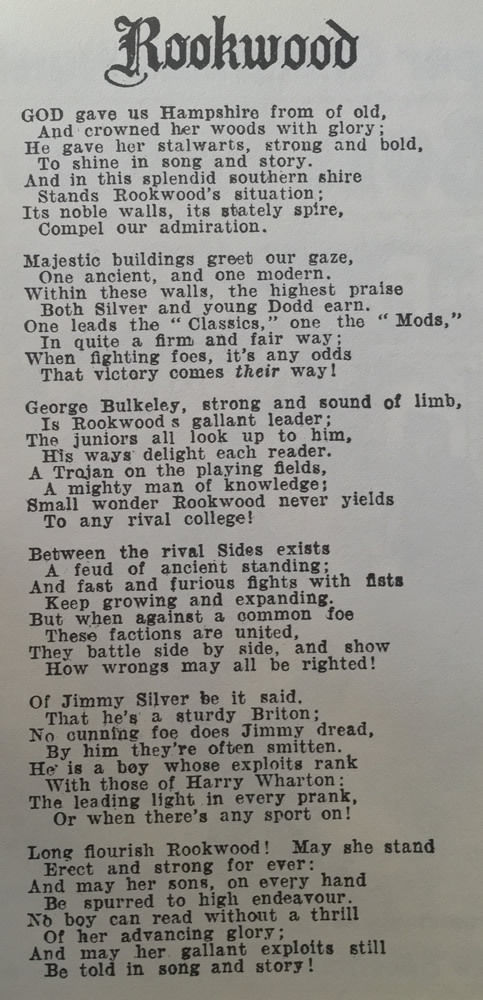 There were lean times in 1917. School prizes were non-existent, sweets had disappeared from the shops, the Winter had been bitterly cold and we were expected to eat less bread. News from the war-front was bad and the local school meals were uneatable, but on Friday evening it was always a special occasion. School was over for the week, bedtime was relaxed and nothing could mar our joy in the care-free and pre-war antics of Wharton and Merry, to which we now find added the delights of Silver.
The Charles Hamilton Companion Vol.5 (3)The Magnet and Gem had lost something of the attraction of the red and blue cover days. Macdonald had been succeeded by Warwick Reynolds, a good artist in his own field, but his figure drawing was over—large •and sometimes distorted. Pentelow was busy writing in a style that was unsuited to boys’ periodicals so that altogether, it was a disappointing period that offered little relief to the variety of discomforts listed above.
The wilting of the Magnet and Gem under the stress of war is not difficult to understand, but the invention of a new school for the Boys’ Friend, and Cedar Creek at a later date, must have over-taxed even Hamilton’s prolific output. A creative and inventive genius is splendid to behold but under this kind of pressure it cannot meet the editorial date-line each week. Of course, the ten-year old reader of those early days knew nothing about the trials of the Amalgamated Press, but he did know that the stories in the Popular were vastly more entertaining than some of the current productions, and that Rookwood was beginning to occupy a place in the affections that refused to be denied.
The Charles Hamilton Companion Vol.5 (5)The Jimmy Silver contribution to that first trio of School Stories, dealt with schoolboy theatricals that began soberly enough but ended in a riot. Hamilton loved the river, and river stories, but he was also a very good actor and his accounts of school plays are always told with gusto, and un- mistakable delight in the chaos that always attended these early adventures in make-believe.
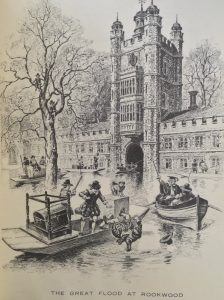 The Sixth Form open the programme with a production that is presented in deadly earnest, and here we have the author’s wry comment on the audience reaction to Bulkeley(the only one who was any good, according to Jimmy Silver) and the supporting cast.
“It is not our intention to give a description of the Sixth Form dramatic performance. It must have been good because all the Sixth in the front seats clapped and cheered most heartily, and Dr. Chisholm and the vicar applauded.
But for these circumstances, some of the audience might have thought that it was bad. The Fistical Four and their companions applauded too, but, as Jimmy Silver remarked, they were not applauding the acting.
‘These chaps don’t know how to do things,’ Jimmy Silver remarked. ‘But we ought to encourage them and they’ll make greater efforts in the future. They can’t do things in our style, of course, but we ought to encourage the Sixth.’
The Charles Hamilton Companion Vol.5 (4)The vicar clapped because the fund was being raised for his church. The masters clapped because the cause Was a noble one. The Sixth clapped because the actors belonged to the Sixth. The Lower Form boys clapped because the Sixth clapped. The outsiders clapped because everybody else did and they thought the vicar must surely know whether the performance ought to be clapped, or not.

Consequently, there never was such a clapping heard before within the walls of Rookwood and the blushing actors came many times before the curtain to receive their calls.”
It is recorded that later that evening Tommy Dodd ruined the vicar’s watch in the course of a series of conjuring tricks, which the vicar, being a vicar, had to pretend that a few hammer blows meant nothing to a watch, but it was Silver who was destined to provide the most stimulating entertainment of the entire performance. Resplendent in full evening dress, the Captain of the Fourth advances to the footlights to announce the presentation of famous historical figures in wax, but with the added attractions of movement and speech at the merest word of command. Unfortunately, these carefully laid plans did not survive until the end and the fun was very fast and extremely furious.
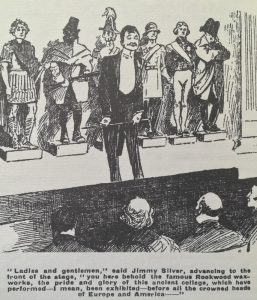 “The fat country lad rose from his seat. ‘May oi come on and look at them close measter? he enquired. ‘Certainly if you like!
The country youth advanced upon the dais he looked at Napoleon. Napoleon kept an absolutely unmoved face, staring straight before him at the audience, and the country youth was satisfied. He passed on to Julius Caesar and thought he detected a slight twitch of the Roman’s eyelid. His hand went closer to the waxwork with a pin in it. The next moment there was a terrific yell that nearly made the countryman jump out of his boots.”
The Charles Hamilton Companion Vol.5 (1)It was Raby, of course, who finally gave the show away as the over-talkative Irish moonlighter in combat with a Cavalier.
The Mysterious X
 £5.00 inc P&P – Buy Now via Ebay
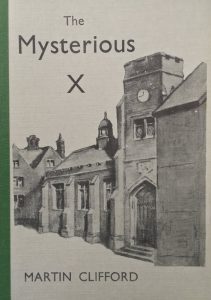
Charles Hamilton once declared that the element of mystery in his school stories was never intended to be important: otherwise, once suspense was known, the story would never bear re-reading. The mysterious X series does not conform to this rule, however, as the identity of the criminal and his mode of operation are both kept secret until the dramatic (and rather stagy) climax at the end.
Written in 1912. The heyday of the blue Gem, these two stories “Baffled” and “Caught Red Handed” immediately involved the reader in a puzzle that revolved around the adult personalities of Glyn House and St. Jim’s. Before committing his audacious burglaries, the Mysterious X used to ward his intended victims in advance of the exact at which he would commit the crime. Clearly there was a novel and intriguing element introduced into this pair of stories, and it is not surprising that they have achieved somewhat of a reputation in collecting circles for this alone.
 The Mysterious X (1)Other aspects of these tales are less important than the element of surprise. I personally find that stories of Bernard Glyn and his inventions are usually tedious. I prefer character study to gimmickry, and consequently the conversation between D’Arcy and Ferrers locke, in which Sherlock Holme’s methods are greatly satirised, provides me with the greatest source of pleasure. Nethertheless, whatever your particular interest may be, I feel certain that you will derive much enjoyment from reading a pair of stories that well deserved to be granted a new lease of life that this re-printing affords. – Roger Jenkins
Tom Merry and Co & Tom Merry's Conquest
 * PLEASE NOTE this publication comprises two stories, printed back to back, under one cover.
£5.00 inc P&P – Buy Now via Ebay
These two copies of the Boys’ Friend Library were originally published a long time ago, No. 30 in November 1907 and No. 38 in January 1908. They appeared in the era of the halfpenny Gem when Tom Merry reigned supreme and the Magnet had never been heard of.
They were an astonishing tribute to the popularity of the St. Jim’s stories which at that time ran to a mere seven or eight chapters each week. These monthly volumes were new stories each of 120 pages, and even today the zest and vigour of the writing sweeps the reader along with it. It is easy to appreciate that Charles Hamilton himself relished the elbow room Provided by this format, and there is not the slightest suspicion of padding, It is a known fact that the readers of the day also appreciated these two stories, for they were quickly sold out, and they have now become collectors T items.
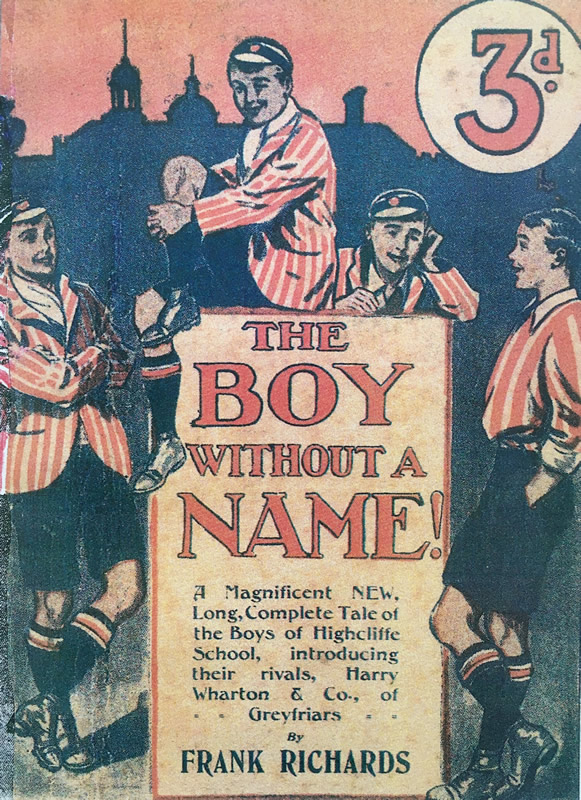
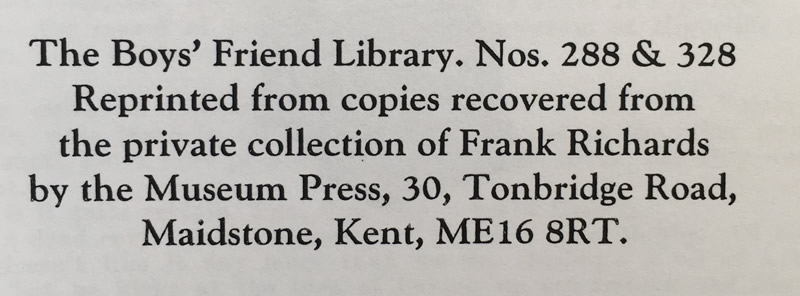
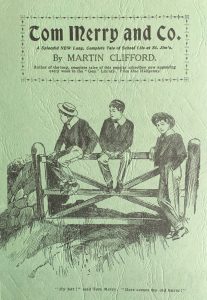 In a way they bear comparison with the two Highcliffe Boys! Friend Libraries which were republished by the Museum Press some years ago. “Tom Merry & Co” like “The Boy Without a Name”, is complete in itself. Nevertheless, public demand necessitated a sequel in each case, and “Tom Merry’s Conquest”, like ‘Rivals and Chums”, cunningly utilised the earlier theme and extended and renewed it in an unexpected fashion. There, however, the comparison ends. The Highcliffe stories were dramatic, full of tension and even painful moments, whereas these St. Jim’s stories struck an entirely different note. They introduced Rylcombe Grammar School in. to the St. Jim’s saga, a hardy annual that survived to bloom and blossom again and again in future numbers of the Gem. These stories are a light-hearted account of a competitive jockeying for position, an essay in one-upmanship, though they do possess some serious undertones. Perhaps their most interesting aspect is the development of the characters of the St. Jim’s juniors, particularly Gussy and Tom Merry, whose sunny untroubled nature (before the arrival of Lumley-Lumley and Levison and Talbot) was never better exemplified.
The Greyfriars Commentary and Book of Verse
“In recent times it has become fashionable for authors to publish a likeness of themselves somewhere in the volume for sale, although it is doubtful if the reader is interested in the face behind the pen. However, not to be outdone, the face accompanies the enchantment, although it may be that the picture pre-dates the narrative by a year or two, both date and age being somewhat uncertain.”
 Introduction
£7.00 inc P&P – Buy Now via Ebay
A glance at the first issue of the Charles Hamilton Companion yields the astonishing fact that it was published in 1972. We are now seventeen years older, having prepared, printed and dispatched seven issues, with the eighth now nearing completion.
Like Greyfriars, Charles Hamilton is a permanent institution from which there is no escape. Apart from his travels abroad his life was unremarkable. He was a very private man and did very little but tap the typewriter, smoke a pipe and read Horace. But such things were born in the elderly typewriter and the place of birth, and the unimportant conditions thereof, are of no account. The imagination takes wings and carries us along with an effortless ease that we can seldom resist and knows nothing of the limitations of time, or place.
Thee Greyfriers Commentary and Book of Verse (1)The bulk of juvenile literature was intended for the leisure hour and then to be put away with other childish things, but this was not to be and our old numbers have become prized possessions with increasing value as the year’s advance. Genius sprouts in the most unlikely soil and it is sufficient that out particular genius gave of himself so lavishly for more than thirty years for a mere penny, or twopence a story, to be followed by a host of memories that never appear to fade, and represent an enormous interest in the initial investment; in fact it becomes a compound interest that grows with the years and provided a dividend far beyond the expectations of those far off days when times were hard and pennies were difficult to find.
Charles Hamilton was a man of letters and a gifted linguist. Why should he elect to confine these talents to the writing of stories for the cheap juvenile press, commonly known as the ‘Penny Dreadfuls’ it is as great a mystery as his mastery of storytelling. Clearly he could have become a famous author in his lifetime, instead of writing in obscurity and attracting little attention until the closing years, when the old papers had long since vanished. There is no doubt that he preferred anonymity and we must be grateful and we must be grateful that he found such satisfaction in the society of his own creations, and not the real world of constant development and competitive finance. The outside world had little effect on the Greyfriars tradition and the outcome of all competition was well known in advance. It was a comfortable place, never lacking in new events, or new crisis, week by week, but always with a resolution in the last chapter, or at the end of a series so that, once again, “All was calm and bright.” Daydreaming is a common experience and it must have been fun living in a world of make-believe for hours on end where anything could happen, and often did, but always subject to the manipulative skill of the dreamer.
It could well be true that some of the daydreaming rubbed off and the reader became hypnotised. This was the trouble with the substitutes, of course, the total lack of dream-reality providing nothing to stimulate the imagination. The prosaic attitudes of the editorial departments in the Fleetway House could scarcely be relied upon to produce an inspired story comparable with those coming off the old Remington with such facility in the quiet reserve of Roselawn, or Appletrees. According to C.M Down, there were times when the Hamilton manuscript failed to arrive, and it became extremely difficult to meet the Friday night deadline. This was often the case then C.H was enjoying the delights of continental life.
Charles Hamilton once described himself as a poet. A flight of fancy that was only supported by his gift for parody, severil of which have been included in this volume. G.R Samways relates how he sent some of his jingles to the Magnet office, which were published and lifted him “From a state of poverty to one of un-dreamed affluence.” He was then urgently called to Fleetway House, and the poetry marked the beginning of his association with the Companion Papers. We can enjoy the poems, of course, and pretend that the author is a chap called Dick Penfold or Peter Todd. A more authentic poet is to be found in Tony Rees whose verse is also included.
Our late lamented friend, C.H. Chapman is represented by is illustrated Nursery Rhymes and the famous John Gilpin. Although not Greyfriars, the illustrations are the best of Chapman and it is fitting, surely, that the man who dressed Bunter in the familiar check trousers, and spotted bow tie, is worthy of a place in these pages. The other Magnet artist, Leonard Shields, is discussed by Roger Jenkins, accompanied by a selection of his drawings. Roger has also contributed a splendid article on the Hamilton art of writing. The Bully of St. John’s is reprinted from the Diamond Library by the Aldine Publishing Company, and written by ‘Clifford Owen’. It is number 36 in the series, 64 pages long and priced at one penny. The familiar ingredients of the later schools are all here, and with all the promise of greater things to come. The original copy was kindly loaned by Mr Nick Godfrey. We are indebted, also, for contributions from L.M Allen, James Hodge, Earnest Holman and the late Esmond Kadish.
We have been privileged, by kid permission of the author and the B.B.C., to publish a talk entitled ‘Master of Greyfriars’ by Jeffery Richards, and broadcast on the 23rd of October 1988. Our contribution on Narrative Style covers a well-worn path familiar enough to the older members, but yet offering some points of new interest to our younger readers.
Finally, we have a glimpse of a past generation of Hamiltons when Charles was young, kindly sent to us by Mrs Patricia Hamilton. Grandpa must have been fun. There are, also, some delightful ‘period’ photographs.
Looking back over the years is common practice, the memories being somewhat mixed, the less than happy getting in the way of better times, but if we turn back the pages of our old books, then it is fun all the way. The Museum Press joined in these celebrations with the first menu in 1963, continuing every and representing a colourful record of all those special occasions in our history. The first re-print occurred in 1966 entitled – ‘A Strange Secret’, followed by those other two great Gem stories ‘The Mysterious X’ and ‘The Housemasters Homecoming’. Next came ‘The Boy without a Name’ and the ‘Billy Bunter Picture Book’.
The Charles Hamilton Companion first saw the light in 1972, devoted entirely to the history of The Gem and Magnet, by Eric Fayne and Roger Jenkins. Thereafter every new volume contained a new subject, or group of subjects and dealing, in turn, with the three major public schools created by Hamilton. In all, some 25 years of club memories which are good to have stowed away and form, in themselves, a tribute to the timeless work of this great little man, and to the unwavering support of his old (and new) readers. Whether, or not, there will be a number nine to follow this eighth issue is unknown at present. It is unlikely that Hamilton law will ever become exhausted, which means that we may still have work to do before the final curtain. We shall see.
A History of the Gem and Magnet
 FOREWORD
£6.00 inc P&P – Buy Now via Ebay
This volume of the Charles Hamilton Companion has been prepared in response to many requests from our friends and members. The project was shelved for some years for the very simple reason that no material was forthcoming, with one exception, and no-one appeared to have any sort of notion what a Companion should look like. Is it an encyclopaedia? A selection of facts and figures culled from the Hamilton writings, or is it just a collection of the best stories and ‘Highlights”?
One thing emerged very clearly: a reference book to cover the monumental output of Charles Hamilton would be monumental indeed and it soon became evident that the collection and collation of all this would involve a great deal of work and research, and would obviously be It was considered a better idea, therefore to take a second look at some of the past publications and to make a cautious , and limited, approach to the vast field of the Hamilton writings by reprinting the best of these. Suggestions were made that the time had come to reprint the articles dealing with the development of the Gem and Magnet which were originally published in the Collector Ts Digest Annual for the years 1953 — 1959 and these now form the bulk of this present publication. It would be difficult to find a more complete and authentic account of the birth flowering and decline of the Companion Papers, than has been provided by the co-authorship of Mr. Eric Payne and Mr. Roger Jenkins.
 Mr. Payne has been a lively associate of the old papers for many years, and Mr. Jenkins has brought his analytical genius to bear on the many stories and characters in the pages of the Gem and Magnet, from the earliest days of the Old Boys! Book Club. Perhaps it is not for nothing that our authors are members of the teaching profession and it may well be that the admixture of the imaginary and the real provides a stimulus that we, the humble readers, can never hope to fully enjoy!
So much, then, for the history, but what of the great story—teller himself — the man who gave us so much for a few pence a week — Charles Hamilton. For this we go back to a programme broadcast by the BBC on the 27th December, 1962 , almost exactly a year after his death. The contributors to Say You Fellows” were, and are, readers of Frank Richards, as they prefer to call Charles Hamilton, and each member of the team is a skilled observer, in his own field. Nevertheless, the reader is reminded that the analyses and opinions here expressed have not necessarily survived the ten years that have elapsed since the broadcast, and some of the points of view may have become modified, in the light of increased knowledge, Be that as it may, the document offers much that is of interest and we are very grateful to the producer, Mr. Michael Bowen, to Mr. John Arlott, Mr. Alan Gibson and Dr. Ken Smith for permission to print the transmission in the pages of our first Companion volume. Perhaps we can look forward to another broadcast so that we may further unravel the mystery surrounding that extraordinary phenomenon Charles St. John Hamilton.
 The preparation of the third part of this Companion proved to be the most difficult and the final selection of the pictures left much aside that well deserved to be included. Of the four major artists, C.H. Chapman; R, J, Macdonald; Warwick Reynolds and Leonard Shields, each and all have been fairly represented according to Specimens of cover pictures their “length of service’ by the earlier artists have also been included. Perhaps it might be possible, one day, to devote an entire edition of the Companion to the work of the illustrators. may well be that we do not give them credit enough for the part they played in establishing the Hamilton characters in the minds of the youthful readers. Only Mr. Chapman could draw Bunter, or Macdonald Gussy and the pointed, gimlet-like propensities of Mr. Quelch only made their fullest impact under the hand of Leonard Shields. In his own way, too, Warwick Reynolds made a unique contribution in the background detail that was always a feature of his work.
So, we begin the Companion series with some history, a representative selection from the illustrations and a discussion about the author. Already, we have covered upwards of 300 pages and that is enough for any book. Of the nature, and content, of the future editions it is impossible to guess and we must wait to see what opportunities the Wheel of Fortune may present, from time to time
Maidstone 1972
John Wernham
The Boy Without a Name & The Rivals
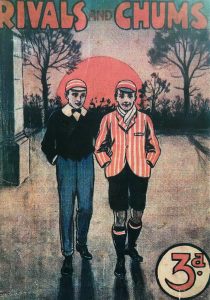

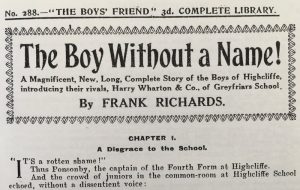
The Charles Hamilton Companion - Centenary Edition
 INTRODUCTION
£6.00 inc P&P – Buy Now via Ebay
There have been several attempts to assess the number of words that Charles Hamilton wrote in his lifetime, and to estimate the equivalent of this enormous output in terms of full-length novels. But, even if the statistics are in some doubt, there can be no question that a writing life of some seventy years without interruption or external interests , coupled with an ease of production and a restless urge to activity, must inevitably have yielded a vast crop of stories, the majority of which have been preserved in a variety of boys’ papers, and have become much prized by collectors.
The object of this present anthology has been to select such of these stories that reflect the genius of the author at different stages of his long career, and the old problems of rejection rather than selection, are no less difficult than has been the case in other issues of this series. Some abridgement has been necessary but this can be an advantage where padding has been introduced to fill out the weekly production. For example, the St. Jim’s story contained two chapters dealing with inter—house feuds, which were great fun but had little bearing on the story-theme and so were safely excluded. Similarly, the opening chapters of the prologue had to be curtailed in the interests of space.
 Having enjoyed the entire volume in the second issue of the Charles Hamilton Companion, it was considered that Grey- friars should be represented only in parody and some original verse. In his passport, Charles Hamilton described himself as “author and poet” and even if his poetry is less original than his prose, his parodies were cleverly done, and well worth a collective airing. Unfortunately, only a proportion of the poems chosen for reprint have survived rejection, and there is a vast treasure here to be researched and published. Of the early works, only a page or two make an appearance, but the lesser schools are fully included in short story form. Christmas is celebrated with some well-known covers and our old friend Herlock Sholmes is in festive mood.
It is with much pleasure that we present articles by Les Rowley and Roger Jenkins on Greyfriars and Rookwood, and a contribution from Mrs.Hamilton Wright dealing with the continental travels during those early years. This throws some new light on that care-free time, although we cannot help feeling that it was a little naughty to recall so many happy hours spent in famous opera houses only to reduce a world famous Italian aria to Gussy rs tenor solo! One can only guess what sort of noise it was and marvel at the unlimited extent of what is commonly known as artist’s (or author!s) licence.
The hundred years dating from the last quarter of the nineteenth, and embracing practically two-thirds of the twentieth, century saw the birth, life and death of a man who was always remote and quite without distinction outside the editorial office. For the better part of fifty years he plied his trade in a literary field that attracted only the amused tolerance of authors and critics. In fact, it was said in some quarters that Frank Richards was merely the nom-de-plume of a team of writers who churned out the stories week by week indicating, with a shrug, that such a system was unworthy, suspect and of no interest to a discerning mind. Even the great Shakespeare suffered in a similar fashion and lost his identity to the “best literary minds of his time.” The flaw in this kind of reasoning is the failure to recognise style, which is peculiar to the individual, and is unrepeatable by any other hand. The other, and perhaps the most important aspect of the case that often confounds the critics, is the element of success. To capture the imagination of so many young minds over so many years was remarkable enough, but now we have new editions, and deluxe editions, while the first editions command record prices.
 Evidently Pentelow recognised Frank Richards! unusual gifts during his short term of service in the editorial chair, as we have recorded in his question to the author: “How the dickens do you do it?”. As to style there is a gentle buoyancy in the writing and a rhythmic clarity of expression, so disarming in its simplicity, that the reader is captured without effort and carried away to share in all the impish delights, or fearful escapades that never fail in their steady routines , and of which we never grow weary.
Success came late to Frank Richards. Critics were aroused; the ‘media! were interested; hard-back covers became a reality; Bunter was on everybody’s lips. But all this is the mere acknowledgement of success; a rather frothy acclaim that is not success at all. It is short-lived and soon lost. It has little to do with satisfaction in life, or permanence in time, and nothing at all to do with the solid bed-rock of weekly stories that came relentlessly off the presses to enchant many thousands of youthful minds. Therein lies the miracle. There have been other publications of a like nature that have enjoyed long runs, but the schools and characters have long since disappeared, or are remembered by few readers. There is an unmistakable gap between the Hamilton creations, and those of his contemporaries, that has widened with the passage of time, and maybe it could be said that we are becoming more and more aware of the treasures that were once ours for a penny, and now only remain as a wistful dream, or to be glimpsed at rare intervals on special occasions.
It was no less a person than C.M Down who once remarked that Hamilton’s reputed indifference to monetary matters was quite untrue, and that he could “drive a hard bargain. Other reports show that he was not highly paid and it was the considerable output that provided the substantial income. Perhaps the Amalgamated Press was a tough employer? There is much conflict of opinion here and we shall never arrive at the truth except that he seemed chronically unable to handle his financial affairs. Is it possible that the silk—lined purses of his wealthy schoolboys made an easy spender of their creator? Perhaps he expected the real world to behave like the imaginary one where he spent most of his time, where ‘fivers! and ‘tenners’ were common enough. Of course, he might just have had a healthy contempt for money – a cheerful plight that kept him busy writing stories, stories and more stories, all for our delight for ever and ever more.
Maidstone 1976
John Wernham
The Greyfriars Characters
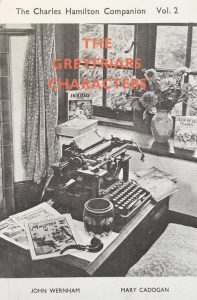 INTRODUCTION
£6.00 inc P&P – Buy Now via Ebay
The preparation of this second volume of the Charles Hamilton Companion has provided its own crop of difficulties in the problems of selection and the time available for research. The field is vast and the characters involved scarcely less so, It was suggested that the Pentelow Gallery should be included, but these are much too lengthy for reproduction and a shortened version is here presented, based on the original material published in 1917 and 1918. In the few years that he occupied the editorial chair Pentelow made his mark in the history of the Companion Papers and, although he was industrious and painstaking, it is doubtful if his style of writing for boys, or his editorial policy was of the kind best suited to publications of this type. Some critics have complained that he wrote too much, created unwanted new characters and intervened in the weekly production, to an extent that had never been the case, in the pre-war days. Certainly, it must be admitted that some of the issues of those days make but dull reading, and memory points to the Popular as the only means of access, in that lean time, to the most real and best stories of Greyfriars, or St, Jim’s.
On the other hand, it must be conceded that writers might well have been scarce in the war years and if the Pentelow reign left something to be desired, and even if his guiding hand was a trifle too heavy, at least, the old papers survived and perhaps, we ought to be grateful to him, for this alone. doubtedly, the ‘Gallery’ was his best contribution and it must be recorded that his careful researches into the Greyfriars archives provided much valuable information and saved much time and work, in this new presentation.
 If this ‘Companion’ is about the Greyfriars characters it is perhaps inevitable that our attention will be drawn to the greatest character of them all – Charles Hamilton himself. There is no record of his schooldays and if his early teaching was confined to the Church, or Government controlled schools of those days, it could only have been a poor consolation to the aesthetic tastes, and lively imagination of the young Hamilton. Languages were rapidly absorbed and writing came easily to him. He loved the sea. He built a pond in the garden of his tiny house – Appletrees, and often sat in a boat thereon writing, no doubt, about another escape from Popper’s Island! His several appearances at Greyfriars as a poor scholar were always good salty stuff (not to mention Dick Trumper the Council School Boy). It was customary for the noble lads to impress and reform chaps like Vernon-Smith and the Caterpillar. In the latter case, the friendship blossomed and settled down, but Red- wing suffered much, and long, at the hands of his wayward study-mate. There were many good stories concerning these two and the struggle between the sturdy fisherman and the harsh nature of Vernon-Smith provided the ideal media for the telling, and re-telling, of all the moral issues that frequently enliven the relationship between such entirely dissimilar characters.
Hamilton was an unashamed moralist and there was never any hint of impurity in his school stories, but he was never maudlin or self-righteous. The wicked received their due and proper reward; the rich suffered the burden of riches, while the good boys were brave and true without any trace of excessive piety, or the brand of sickly priggishness that afflicted some of the earlier schoolboy creations. Even our dear, splendid, guileless Alonzo gains our affection and not our contempt. This, alone, is a remarkable achievement and it may be true that only Hamilton could take a simple duffer and make him a charming hero. Perhaps it is even more remarkable that Uncle Benjamin should enjoy his little pinnacle of fame and scarcely put in an appearance in the pages of the Magnet. If he ever did? The art of drawing a moral without appearing to do so demands a sure, but delicate hand and Charles Hamilton enjoyed these attributes in a measure that never failed him throughout his writing career.
 The question of moralism in story-telling has a corollary in television that is beyond all argument. In these modern times of picture entertainment, there is no small number of detectives and policemen who shoot and shock their way through a maze of brief and complicated scenes, moving at breakneck speed, with an accompaniment of bells, sirens and screaming tyres, with plenty of corpses, according to the needs of the story or the tastes of the author. The dialogue grows ever more cryptic and the plot development is lost and obliterated in the haste and bustle to capture our jaded interest.
However, there is one exception to this hurdy-gurdy turnover of “cops and robbers”, a story-serial that has enjoyed the longest run of all similar series – none other that our old friend, “Dixon of Dock Green. Here we have simple dialogue and simple stories in which violence does not play a leading part. The success of this particular portrayal of police life rests entirely on characterisation and even the thugs manage to retain a touch of humour or a sufficient quantity of, at least, the basic elements of good behaviour, in the midst of their wrong-doing. The policemen do not bark at each other and the final scuffle is content with fists rather than guns. If James Bond had dared to somersault into the Dock Green ‘nick! it is unlikely that his peculiar life-style would have had much effect on the quiet routine of that orderly establishment. Shock tactics must grow ever more shocking and the viewer, or reader, grows weary of the unpleasant matrix of monstrous brutality. But Dixon is still telling his little stories’ on television, just as Hamilton did in the Magnet, and we can enjoy the best of both worlds.
The emergence of Bunter during the second half of the life of the Magnet can only have been the result of popular appeal, yet it is not altogether clear how this came about. There is no evidence that readers were ecstatic about Bunter and he possessed no particular brand of virtue, or evil, to make him interesting. Perhaps it was the generous mixture of fatuous wickedness and the bland attempts to profit from some piece of accidental good behaviour that penetrates our self-protection, and reflects our own extremes of weakness in this fat specimen of the human race. Nothing is missing from this preposterous, voluptuous, thick-necked paunchy schoolboy. He hated work, getting up in the morning, washing or any kind of activity outside his own earthy interests. With motives often in question, the ‘egregious Owl’ wrought much havoc among his fellows, grasping any advantage that came along and seeking only to satisfy the immediate need at any cost, or sacrifice, provided that he neither paid, nor suffered.
The popularity of Bunter can only be explained on this basis of self-reflection. We are all Bunters. We can scarcely admire Bunter as we might Bob Cherry, or Wingate, and we cannot condemn him, as we do Vernon-Smith or Ponsonby, for the plain and simple reason that we could never be so cheerful, or noble, or so ill-natured or vicious as the members of this quartet but, we so nearly resemble this uncomfortable creature that we are quite unable to resist following his horrible little adventures that so closely match our own daily routines.
No survey of the Greyfriars characters would be complete without mention of their female counterparts – the Cliff House girls. It can be argued that when Charles Hamilton was writing about girls he lacked the subtlety and sureness expressed in his boys’ stories. Exposure to feminity tended to make him lapse into either sentimentality or farce, but it must be remembered that Hamilton did not have the time or opportunity to develop his fictional girls.
However, they had their moments! We hope that this volume will revive memories of their part in the Greyfriars saga: although the Cliff House characters were taken over, and improved, by other writers, several generations of schoolgirls regarded Charles Hamilton – the creator of their heroines – as their favourite author. Without him, and the MAGNET, their world would have been immeasurably poorer.
Hamilton the man is a shadowy figure about whom there is little to tell and less to know. He was a friendly man without friends; he was a kindly man, but he moved only briefly among his associates, appearing but rarely at the editorial offices; and as for the artists employed to depict his characters, he seldom evinced any sort of interest in their work. He lived in his own world, but it was not his at all; it belongs to us, every man and boy therein, permanently and for ever. The imaginary world that he created is not bounded by a life span and it is unlikely that Greyfriars, and St. Jim’s, and Rookwood will ever cease to echo to all those familiar noises that began in the quiet of a back room, in some unpretentious dwelling, somewhere in Kent, not far from Greyfriars.
Maidstone 1976
John Wernham & Mary Cadogan